Halloween Candy Won’t Make Your Kids Hyper, According to 23 Studies

Halloween has perfect conditions for sugar to end up on trial. Kids run from house to house, wear costumes, shout with their friends, and come home with a bag full of candy. Then they eat a few more pieces than usual, and the living room suddenly looks like a place where no one will be falling asleep anytime soon.

Still, the evidence does not support the idea that Halloween candy itself causes hyperactivity in most children. A meta-analysis published in 1995 included 23 controlled experiments and found no measurable effect of sugar on children’s behavior or cognitive abilities. That included attention, schoolwork, and directly observed behavior.
It is one of those claims that can sound so obvious that few people stop to question it.
Give a group of kids candy on Halloween and watch what happens. Only when you separate the candy a little from the event itself does the story start to look different.
In this article
What the 23 Experiments Actually Found

The meta-analysis combined the results of 16 papers in which children received a known amount of sugar or a placebo. The included experiments had to be blinded, so the children, parents, and people evaluating behavior did not know who had received sugar.
The results were then compared across 14 different measures of behavior and thinking. The range included direct observation of behavior, attention, and task performance. The combined result showed no reliable effect of sugar.
The authors left open the possibility that a very small effect could exist in some children. The data did not support the large behavioral change that parents often describe after birthdays, holidays, or evenings with lots of sweets.
That is especially relevant before Halloween. A child gets a costume, permission to be outside at night, the company of other excited kids, and a bag that complete strangers fill with candy. For a six-year-old, that is a pretty good recipe for excitement even without help from glucose.
Sometimes Parents See What They Expect to See
One experiment from 1994 adds another useful part of the story.
It involved 35 boys between the ages of five and seven whose mothers believed their children were sensitive to sugar. All of the children actually received a placebo sweetened with aspartame.
Half of the mothers were told that their sons had just received a large amount of sugar. Those mothers later rated their children as significantly more hyperactive. Video recordings of the interactions also showed that they stayed physically closer to their children and tried more often to control their behavior.
If a parent expects a child to race around the house after a handful of candy, every jump off the couch may stand out. The calm five minutes between two bursts of energy can be much easier to forget.
Teeth Are at Much Greater Risk From Halloween Candy
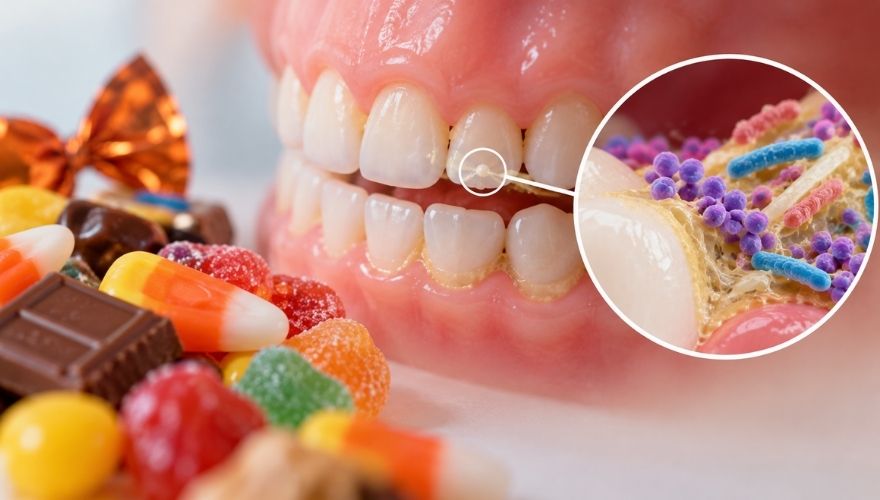
If there is a reason to limit Halloween candy, dental health deserves more attention than the old hyperactivity claim.
Bacteria in dental plaque use sugars from food and produce acids that lower the pH around the teeth. Repeated exposure to those acids can contribute over time to enamel demineralization and cavities. A higher intake of free sugars is associated with a higher risk of cavities.
Frequency matters here too.
A child who eats a few pieces of candy after dinner gives their teeth a different pattern of exposure than a child who takes one piece every twenty minutes throughout the afternoon. Each new intake of sugar feeds the bacteria in plaque again and affects the acidic environment around the teeth.
A reasonable approach is to keep Halloween candy in one place and serve it at a set time, without turning one evening into a family investigation of every Snickers bar.
Dr. Ellie Phillips explains in her TikTok video why Halloween candy poses a greater risk to children’s teeth than to their behavior, highlighting how frequent sugar exposure can contribute to cavities.
Still, It’s Just One Night a Year!
The myth matters mainly because it distracts from what the evidence actually shows.
Maybe the child is simply very excited because it is Halloween.
And if a six-year-old receives a whole bag of chocolate simply for wearing a costume, excitement hardly needs a scientific explanation.