
A Doctor Cracked the Knuckles of One Hand for 60 Years to Settle an Argument

As a child, Donald Unger heard a warning millions of people have heard: keep cracking your knuckles and one day you will get arthritis.

His mother believed it strongly enough to leave young Unger with a question that stayed with him far longer than anyone in the family probably expected. He decided to test what would happen if he exposed one hand to the habit and left the other alone.
After several decades, he had a clear result. Unger found no arthritis in either hand. Later research with larger groups of people mostly pointed in the same direction. Based on available evidence, regular knuckle cracking does not appear to be a risk factor for hand osteoarthritis.
Unger ran the experiment on his own hands for more than half a century. He published the result in a medical journal. He kept up the habit. In the end, he even received an Ig Nobel Prize for it.
Plenty of family arguments are forgotten. Very few end with an experiment.
In this article
The Experiment Started Long Before It Reached a Medical Journal
Unger was a physician and allergist in California.
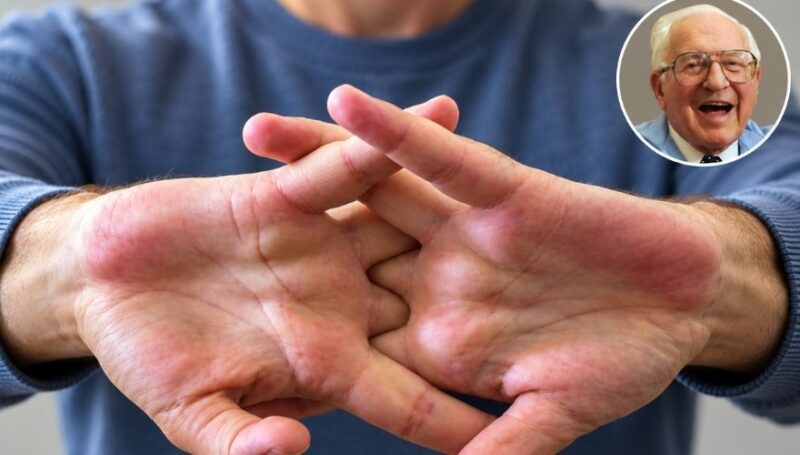
According to a 1998 report by the Los Angeles Times, Unger had cracked the knuckles of his left hand at least twice a day for about 50 years at that point. He deliberately left his right hand alone. After half a century, he compared both hands. They looked similar. He found no arthritis in either one.
That same year, he published a short paper titled Does knuckle cracking lead to arthritis of the fingers? in Arthritis & Rheumatism. PubMed classifies it as a case report and letter, which says a lot about how unusual the experiment was. The paper had one author and, in a very literal sense, one subject.
What Happened When Researchers Added More People

One of the more useful later studies appeared in 2011. Researchers reviewed data on 215 people between ages 50 and 89 who had previously received an X-ray of the right hand. Among them, 135 had radiographically confirmed hand osteoarthritis. Another 80 did not.
About 20 percent of the participants said they cracked their knuckles. Osteoarthritis was present in 18.1 percent of people with the habit and 21.5 percent of those without it. The difference was not statistically significant. Researchers also found no significant link based on the number of years a person had cracked their knuckles or the total amount of knuckle cracking over time.
An older study included 300 people over age 45. In that group, 74 regularly cracked their knuckles. The authors found no higher rate of arthritis among them. People with the habit did show more hand swelling and weaker grip strength.
That second result is interesting, but it calls for caution. The study was observational. It cannot prove that knuckle cracking itself caused weaker grip strength or hand swelling. People who cracked their knuckles also differed in other habits.
Later research did not offer a clear reason to classify the habit as harmful to hand function. In a study of 40 healthy adults, researchers found no greater weakness or swelling among people who regularly cracked their knuckles. In other words, the arthritis claim has fairly weak support in the available research.
How a 50-Year Experiment Became a 60-Year Story
One small detail can confuse anyone who checks the older sources. The original 1998 story describes about 50 years of knuckle cracking.
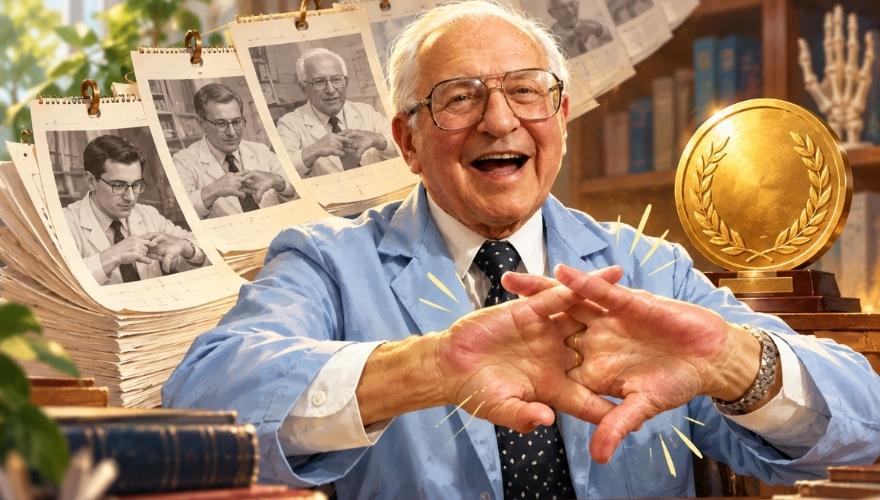
Eleven years later, when Unger received the Ig Nobel Prize in Medicine, the organizers described his experiment as a project that had lasted more than 60 years.
Unger published his result after about half a century, then kept the habit. By the time he attended the Ig Nobel ceremony in 2009, the experiment had passed the six-decade mark. The Los Angeles Times reported at the time that 83-year-old Unger had started as a teenager after his mother warned him that knuckle cracking would lead to arthritis.
After the first 50 years, Unger apparently saw no reason to stop the experiment.
Then Came the Ig Nobel Prize

The Ig Nobel Prizes have an unusual standard. Organizers choose research that first makes people laugh and then makes them think.
Unger’s experiment fit almost perfectly.
At the ceremony, he said: “I’ve gotten a lot of awards and degrees, and all of a sudden I get my 15 minutes of fame out of this stupidity,” Unger told the Los Angeles Times.
A person can spend an entire professional career on serious medical research. The world may still remember him for six decades of annoying people with the sound of knuckles on one hand.
Did Donald Unger Really Settle the Argument?
His experiment alone could not provide an answer for everyone. Later data, however, point in the same direction as the result Unger saw in his own hands.
That does not mean pain during a knuckle crack deserves no attention. Pain, swelling, or a change in joint movement pose a different question than painless, voluntary knuckle cracking.
Donald Unger started with one left hand and an argument with his mother. Six decades later, he had two hands without arthritis, a published medical paper, and an award for an experiment that probably lasted longer than the argument itself.
Mothers often have good reasons for their warnings. In this case, one warning received an unusually thorough second test.