
A Hat Keeps You Warm, but Not Because Your Head Leaks Half Your Heat

If you ever tried to go outside without a hat during a harsh winter as a child, you probably heard that half of your body heat escapes through your head.

Sometimes the number was 40 percent. Other versions pushed it as high as 80 percent. It sounds like one of those facts no one checks anymore because everyone already seems to know it.
A hat really does help you stay warmer, but the human head does not have a fixed heat-loss rate of 40, 50, or 80 percent. Heat escapes across exposed body surface, so the share lost through the head depends on how much of your body has insulation and what conditions you face.
The parental advice was good. The number attached to it was not.
In this article
A Few Useful Facts:
- An adult head accounts for about 7 percent of total body surface area.
- In 17°C water, head submersion with the rest of the body also exposed raised total heat loss by about 11 percent.
- If the rest of your body has good insulation, an uncovered head can account for a much larger share of the heat that still escapes.
How the Head Got Its Reputation

The claim often has a link to U.S. military cold-weather survival material. One manual published in 1970 gave an estimate that 40 to 45 percent of body heat could escape through the head in cold weather.
The problem appears once the original context disappears. People in extreme cold had heavy insulation over most of the body, but the head often stayed exposed. If almost all major skin surface has protection, the small uncovered area naturally accounts for a much larger share of total heat loss. An account of how the famous rule began points to that detail as a major reason the number later survived without the conditions that produced it.
Picture a thick winter coat, good pants, and one bare hand. That hand would now make up a much larger share of all exposed skin. It still has no special power to drain a huge share of heat out of your body.
How Much Heat Actually Escapes Through the Head?
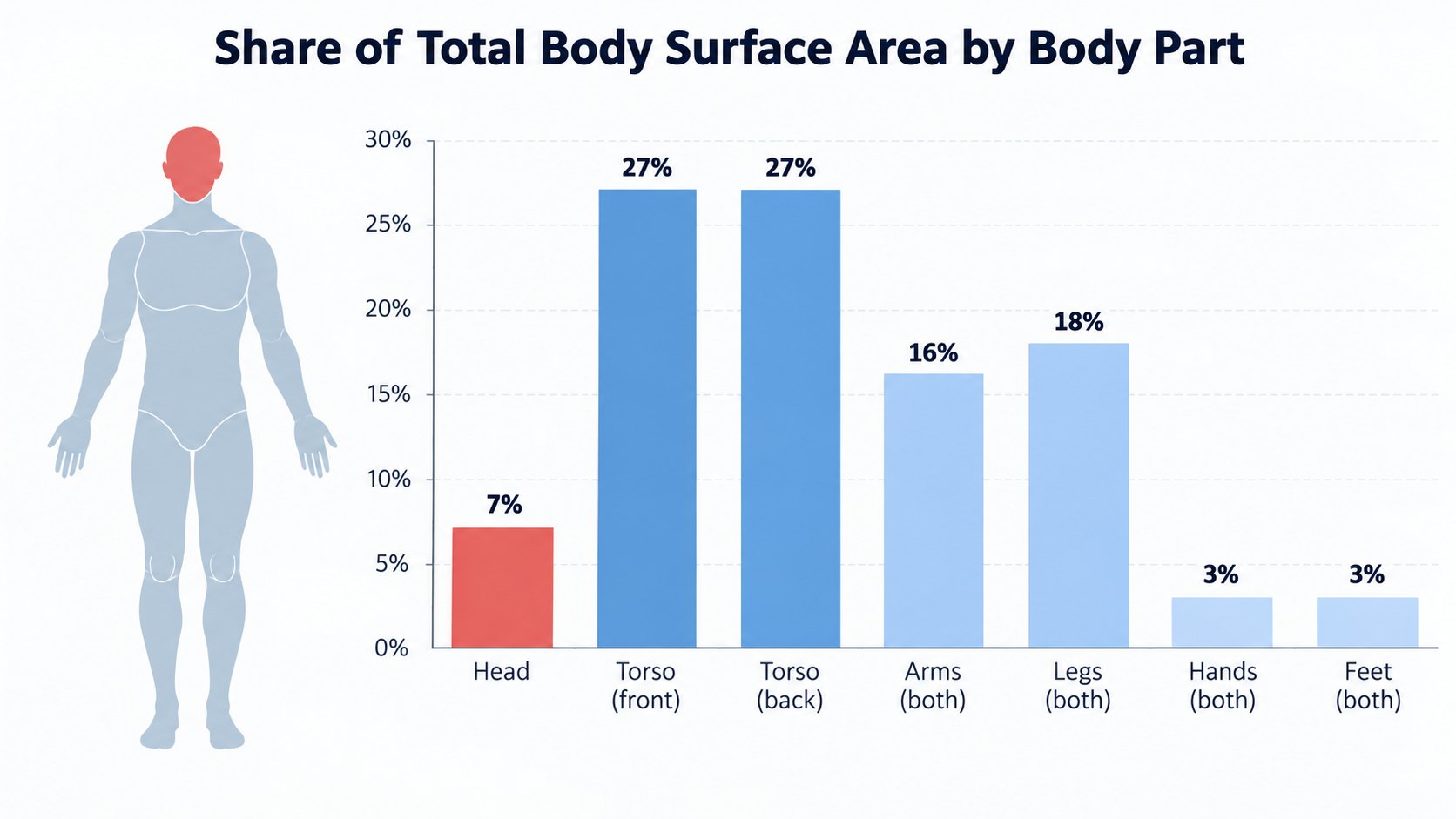
About 7 percent offers a useful reference point. That is roughly the share of total body surface area represented by the head in an adult.
One unusual way to test the idea was to expose the entire head to cold water.
Eight healthy men entered water at 17°C. Researchers changed two factors: body insulation and head position above or below the water. When the body also had exposure to cold water, head submersion, with the head at about 7 percent of total body surface area, raised overall heat loss by about 11 percent. Results of the cold-water head-submersion study paint a very different picture compared with the familiar 50 or 80 percent claim.
Cold water is not the same as a walk through winter air, of course. An 11 percent figure should not become a new universal rule.
In similar experiments, head cooling also sped up the drop in core body temperature more than surface area alone might suggest. Whole-head exposure to 17°C water raised the rate of core temperature decline even when the body had insulation.
So Why Can a Hat Make Such an Immediate Difference?
The head and face react strongly to cold, so the change after you cover them can feel quite noticeable. Add a winter coat zipped up to the neck and well-protected legs, and the head can suddenly become one of the largest body areas left fully exposed.
A Hat Is Still a Good Idea
After a myth falls apart, it can be easy to go too far and decide that a hat does not matter much after all.
There is no reason to leave a hat at home just because the old 50 percent claim failed the test.
Next time you head outside in the cold, put on a hat. The fact that it helps preserve body heat is reason enough.